This page introduces you to the essential guitar scales and modes used in jazz and modern music.
Each scale is explained with clear diagrams, practical fingerings, and straightforward theory to help you understand how they work and when to use them.
Use these materials to strengthen your technique, improve your ear, and develop the skills needed for confident improvisation.
What's A Scale In Music?
A scale is a sequence of ascending or descending pitches that form a palette of notes that can be used to create melodies or improvised lines.
The notes have differing intervals between them, sometimes it's one half-step (semitone), other times it's a whole step (two semitones).
✔︎ Diatonic scales (constructed from a mix of half-steps and whole-steps)
✔︎ Chromatic scales (every half note in an octave).
✔︎ Whole-tone scales (notes a whole step apart).
✔︎ Pentatonic scales (five notes per octave).
✔︎ Hexatonic scales (six pitches per octave).
✔︎ Bebop scales (eight notes scales).
✔︎ Symmetric scales (equal division of the octave).
Scales can even include quarter-tones and micro tones in the music of other cultures.
What Is a Musical Mode?
A mode is a specific type of scale. Each such sequence created by starting on a different note of a scale is a mode of that scale. In other words, a mode can be seen as a scale within a scale.
You may obtain multiple lessons covering the primary guitar scale types for free by clicking on the links below.
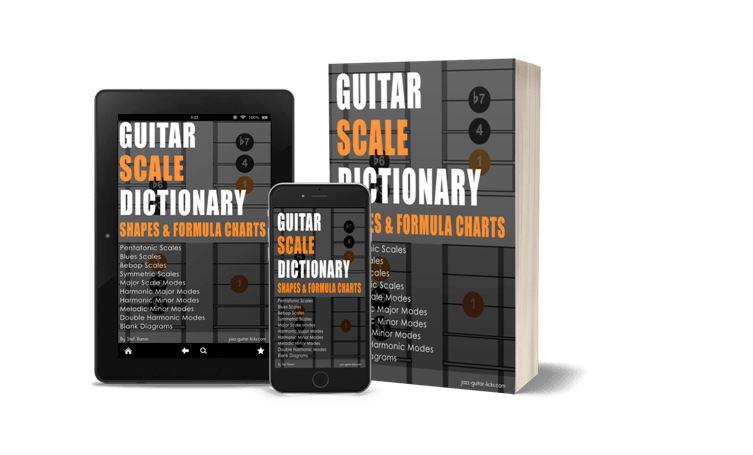
The following pics below show the PDF methods that deal with scales.
You will find below lesson providing guitar scale charts, shapes, theory, tabs and exercises for practicing modes on guitar. Click on the links to access the categories.